Showing posts with label Christianity Today. Show all posts

Monday, February 25, 2013

Firehouse Accountability

Firehouse Accountability
There has to be a better way to look out for each other.

Friday, February 22, 2013

Our Moral Position


"Evangelical Christians are now called upon to think strategically about what it means to speak truthfully and lovingly to a society that increasingly sees us as the moral outlaws. Clearly, we must watch our speech carefully, measuring every word for truth and tone and avoiding incendiary sound bites. We must also guard our hearts toward the persistent temptation towards self-righteousness. But, at the same time, even the most humble statement of biblical truth can now be turned into a sound bite described as hate speech and a refusal to affirm the normalization of homosexuality is turned into repulsive intolerance. We now face no shortage of arguments for capitulation, but abandoning the truth of God's Word is not an option. We deny the gospel if we deny the sinfulness of sin. That sin. Every sin. Our sin."

(Extract from "Tebow's Big Fumble" written by  R. Albert Mohler, Jr. at Christianity Today dated 22 February 2013)

Wednesday, October 17, 2012

The Love We Dare Not Ignore - It's a profound mistake to neglect our gay brothers and sisters in the body of Christ.


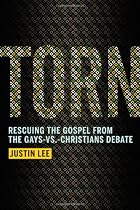
Torn: Rescuing the Gospel from the Gays-vs.-Christians Debate
OUR RATING
3 Stars - Good
BOOK TITLE
Torn: Rescuing the Gospel from the Gays-vs.-Christians Debate
AUTHOR
Justin Lee
PUBLISHER
Jericho Books
RELEASE DATE
November 13, 2012
PAGES
272
PRICE
$11.95
Next time you're with a group of evangelical Christians, try this exercise in free association: What comes to mind when you hear the word "gay"? Whose faces do you imagine? The lesbian couple who live next door, who have been burned by the church and have been dropping hints that they're not too fond of Christians? The barely-clad, gyrating figures in the local Pride Parade? The political activists you watch on the nightly news? The radio show host who said those nasty things about conservatives?
Whatever pictures the label "gay" evokes, you probably don't immediately envision the face of an evangelical churchgoer. Justin Lee, a self-described "gay Christian" and author of the disarmingly vulnerable Torn: Rescuing the Gospel from the Gays-vs.-Christians Debate (Jericho Books), is out to change your perceptions.
Known as "God Boy" in high school, Lee was the kid who wouldn't shut up about Jesus. He came from good evangelical stock: Raised Southern Baptist, in a picture-perfect family, he was outspoken and winsome in a leadership role in his church's youth group. Yet while he was defending his church's traditional position on gay partnerships ("love the sinner, hate the sin," he once repeated to a skeptical fellow student, only to regret it afterwards), Lee was harboring a secret. "Years earlier," he writes, "when I had first hit puberty and all my male friends were starting to 'notice' girls, I was having the opposite experience: I was starting to 'notice' other guys."
At first he tried chalking this experience up to a phase many young men his age went through. He dated girls, focused on his schoolwork, and stayed busy with church activities. But his attraction to other guys didn't diminish or recede. In a particularly poignant passage of his book, Lee recalls holding hands with his girlfriend at a Michael W. Smith and Jars of Clay concert when, in an unbidden moment, he found himself staring at a guy. "I only saw him for an instant," Lee says, "but I couldn't help noticing his attractive features, and suddenly I found my thoughts and emotions rushing toward him. I wanted to know everything about him …. I wanted to meet him, to talk to him, to get to know him, to spend time with him."
Eventually, Lee admitted to himself—and then, later, to his pastor, his parents (whom his book describes as notably mature, compassionate, and sensitive), and a small cadre of trusted friends—that what he was experiencing wasn't just a phase, or a glitch caused by faulty parenting, or an overcharged sex drive. It was something far more quotidian—but also, by the same token, far more central and identity-shaping—than any of those things. Where his friends wanted to spend time with women and (eventually) fall in love, Lee wanted to know and love a man.

Here to Stay

As Lee began telling his story to others, he started to meet more people like him: kids who had grown up in Christian homes, remained Christian believers, and yet found themselves with persistent, apparently unchangeable, same-sex attractions. What was God's will for these new friends? Should they try to rid themselves of their homosexuality? (Lee eventually decided "no." A good chunk of his book is spent discussing his experiences of duplicity and false hope in and among "ex-gay" ministries.) Over a long period of prayer and frank conversation with his fellow believers, Lee came to think that he and other gay Christians should be able to express their feelings for a member of the same sex.
Where did that leave Scripture's prohibitions of homosexuality? For Lee, the answer to that question hinged on how to interpret Jesus' teaching about the centrality of love. True, he recognized, a few biblical passages do condemn homosexual partnerships, but those relationships appeared to be marred by exploitation or idolatry. (This is how Lee reads Romans 1, for instance.) Above all, there was Jesus' more compassionate teaching about love being the fulfillment of the law. If Jesus castigated the Pharisees for tying up "heavy, cumbersome loads and put[ting] them on other people's shoulders" (Matt. 23:4), what would he say to those who asked gay people to live without love?
Surely gays and lesbians are 'out there', somewhere else, not 'here' in our discipleship small groups, or kneeling at the Communion rail beside us—are they?
Out of these convictions, Lee started a ministry, first online and now involving a yearly conference, a regular podcast, and countless speaking engagements, blog posts, and one-on-one conversations: the Gay Christian Network (GCN). The closeted kid who had been the model evangelical child now became the public face of one of the country's up-and-coming gay advocacy groups.
Many of us evangelicals may believe that LGBTQ ("lesbian, gay, bisexual, transgender, queer/questioning") folks are far removed from our churches and ministries. Surely gays and lesbians are out there, somewhere else, not here in our discipleship small groups, or kneeling at the Communion rail beside us—are they? But if Lee, the God Boy of his high school who could quote John 3:16 in his sleep, is an example of what it means to be "gay," then yes, they are. They're here in our churches, and they're here to stay, forcing us to reconsider what it might mean to love our own spiritual siblings.
For his part, Lee is in no doubt about what form that love ought to assume. "Openly gay Christians must find their place throughout the church," he writes. Appealing to the dispute over food that Paul had to confront in the churches he founded (Rom. 14), Lee suggests that we follow Paul's counsel not to quarrel "over disputable matters." Those who believe in good faith that God allows for permanent, monogamous gay relationships (what Lee calls "Side A") and those who believe gay Christians ought to remain celibate ("Side B") can learn to treat one another as brothers and sisters in Christ who disagree over a matter of conscience.

A Place of Transformation

Full disclosure: I am a celibate gay Christian. Like Lee, I grew up Southern Baptist. Like him, I discovered during puberty that I was exclusively attracted to others of my own sex. But unlike Lee, I don't find any wiggle room in Scripture: Marriage is intended for one man and one woman (Gen. 2; Matt. 19; Eph. 5), and anyone living outside that marital state is called to celibacy (1 Cor. 7).
Lee's book leaves people like me—his fellow gay Christians who, nonetheless, disagree sharply with him on sexual ethics—in a difficult position. On the one hand, we share his hope that the church may be a place of welcome and grace for LGBTQ people. However, we don't view our celibacy as simply one option among an array of valid choices which believers are free to sort out as they please. Rather, we see celibacy as obedience to the clear, if bracing, mandate of Scripture. And we've found the church to be a place of transformation, a place to be, in T. S. Eliot's words, "renewed, transfigured, in another pattern."
It's tempting, with Lee, to think that Jesus' ethic of love abrogates some of the more obscure or challenging biblical norms. Yet the sweep of the canon of Scripture suggests that we follow Jesus rightly when we see the apostles' teaching and commands as flowing from Jesus' love for us, not impeding it. "If you love me, you will keep my commandments," Jesus told his disciples (John 14:15, esv). Conforming our lives to Scripture's difficult ethical teaching is precisely the way we demonstrate that we've made our home in Jesus' love. And that's a path that Lee's book, for all its commendable honesty and salutary insight, chooses not to explore.
Wesley Hill, author of Washed and Waiting: Reflections on Christian Faithfulness and Homosexuality(Zondervan), is assistant professor of New Testament at Trinity School for Ministry in Ambridge, Pennsylvania.

Friday, September 21, 2012

Making Too Much of Marriage

The problem is not God's good gift of holy matrimony—it's when we desire it above all else, forgetting the Christian virtue of self-denial. ~ Claire & Eli

Editors note: In Altared: The True Story of a She, a He, and How They Both Got Too Worked Up About We (Waterbrook), Claire and Eli (aliases) reveal themselves as a couple who "met," "dated," and "broke up." Sure, that sounds like the predictable story of innumerable other couples. But Claire and Eli went further. They took stock of their relationship, considered why things had gone awry, and awakened to "the possibility that marriage was less of linchpin to Christianity than we initially thought." And they collaborated on this book, a joint memoir of their courtship spliced with theological reflection on the dangers of allowing blissful anticipations of marriage to distort our understandings of love and discipleship.
"God gave me a desire for a husband or wife, and therefore I know he'll provide one."
Heard this before? We have, countless times. Whether in small groups, post-breakup consolations, late-night talks with roommates, or any number of conversations with other Christians, there was often the sense that our desire for a spouse meant that God would provide one. We're not sure we ever heard it from the pulpit, but quite a few of our friends, and even ourselves at times, thought that longing for a spouse meant marriage was imminent.
But if we desire a husband or wife, does that always mean God will provide one? We can't answer one way or another, of course, but the breadth of the statement and the conclusions drawn from it make us uncomfortable. We ourselves often don't know the difference between our own desires and desires from God. And even if we are sure a desire is from God, can we be sure He'll be faithful in the way we think He will? It would seem that if our desires always translate into a particular outcome from God, then God becomes something like a puppet.
God clearly can and does lead us through our desires, and desires from Him can illuminate, inspire, or provide a loving reproach. At times, holy desires are just the spark we need to orient our lives away from something destructive. And yet it seems there is also wisdom in not being overly sure that God will fulfill our desires in the time and manner we expect. Any time we're positive God will give us something, we must remind ourselves that His ways are above our ways (see Isaiah 55:9), and that our desires should be humbly considered in view of who He is.
As we thought about this in light of marriage, we wondered what Christ's teachings meant for our desires in the average search for a spouse. To be sure, we need to remind no one that the desire for intimacy is a good and God-given gift, a pillar of the created order and God's beautiful design. And yet we can sometimes forget our human potential to distort that design. Sin stalks and stains the beauty of how things might otherwise be.
As we reread the Gospels, we kept stumbling upon a recurring thread of self-denial, the idea that following Christ requires us to let go of the things we have and want. Try as we might, the theme could not be dodged: everything is to be given to Him, and that includes our desires.
A.W. Tozer described the situation this way: "The roots of our hearts [grow] down into things," and this is a danger because "God's gifts now take the place of God, and the whole course of nature is upset by the…substitution." Nature is upset not because the gift is bad, but because we make too much of it, because we treat it as a god rather than a gift from Him. And this is no less true for relationships, one of God's most beautiful gifts. Even marriage can risk replacing God in our hearts (see 1 Corinthians 7). So long as our hearts grow into it instead of God, the gift threatens to replace the Giver.
The more we wrestled with this, we came to see how self-denial is helpful and particularly Christian counterpoint to this, whatever our marital status may be. If self-denial means the letting go of what we want and surrendering it to Christ, as we explore below, and if intimacy is one of our greatest cultural desires, then our desire for relationships seemed like a natural starting point for active surrender to Him. (By this we don't mean a surrender of its importance in our hearts to Him, of our tendency to replace first loves with seconds.) If denying ourselves is a part of following Christ, as the Gospels imply, our deepest desires should be viewed as opportunities to lay down what is dear to our hearts at the feet of Christ. The deeper the desire, the greater the risk we will give it all our allegiance.
But oddly, it seemed self-denial was rather absent from our discussions on romance and love.

Let Him Deny Himself

Jesus often describes following Him in abrasive terms: leaving your father, taking up your cross, selling all you own, losing your life, and so on. We, meanwhile, as modern evangelicals, tend to associate these losses with extreme situations, Job-like spells, or times of great martyrdom. They are not what comes to mind when we describe the typical Christian's life. The fact is, we seldom think about Christian identity in terms of living without or denying ourselves. Rather, we think about denials or deprivations as things inflicted upon us, forgetting that taking up our crosses is an act done willingly, just as Christ did. "If anyone would come after me, let him deny himself and take up his cross and follow me," he said. "For whoever would save his life will lose it, but whoever loses his life for my sake will find it" (Matthew 16:24-25).
Even as we write this, we know we've been guilty of not allowing the fullness of Jesus's words to sink into our hearts. We have looked away in order to avoid any upheaval in our lives—any disruption to our plans, schemes, and desires; we have found excuse after excuse. Perhaps intellectually both of us know that we are to deny ourselves, but in the daily practice of our lives, denying ourselves easily morphs into a convenient slogan rather than a reality.
The giving up of self is an immensely important part of Christian love. In fact, we can't even talk about Christian love without a discussion on self-denial. Frankly, we didn't realize this until we had already begun to formulate our thesis [that in seeking marriage, we had neglected Christian love], but as soon as we picked up the thread of self-sacrifice throughout Christian history—tentatively—we were startled to find that in addition to Jesus, many of the most influential minds in our tradition described following Christ primarily in terms of self-renunciation.
Indeed, as we mulled over the writings of past Christians, our understanding of love grew vastly larger as our understanding of self-denial grew more challenging. The more we read works about the early church—Acts, the Desert Fathers, the lives of the saints, some of the monastic traditions—and the more we read a range of older Christian writers—Augustine, a Kempis, Calvin, Pascal, Teresa of Avila, John of the Cross, Bonhoeffer, Tozer, and Lewis—the more convinced we became that Christian love and self-denial are often two sides of the same coin. We cannot expect to love our neighbor as Christ did until we lay down our lives and the preferences that rule our loves. We cannot place God wholly first until we uproot our hearts and forsake the pronouns my and mine.
Excerpted from Altared by Claire and Eli. Copyright ©2012 by Claire and Eli. Excerpted by permission of WaterBrook Press, a division of Random House, Inc. All rights reserved. No part of this excerpt may be reproduced or reprinted without permission in writing from the publisher.
Further Reading: http://www.scribd.com/doc/92096722/AltarEd-by-Claire-and-Eli-Chapter-1-Excerpt#.USGYSR2nCa8

Thursday, July 1, 2004

Beyond "Prayer Requests" - What if people's wishes run counter to God's sometimes painful path of transformation?


You'd have thought I'd just cussed by the way the mouths around the table soundlessly fell open. And all I'd said was "I don't think I can pray that for you."

The woman who had just asked us to pray was perhaps the most shocked of all.
My home group had just finished eating dinner, and we were sharing prayer requests. With obvious distress, Kris had told of her daughter's plan to move in with a boyfriend that weekend, and asked us to pray that God wouldn't allow it.

I usually try not to take exception to people's prayer requests, but I have a low tolerance for requests I think God clearly will not answer. On this occasion, I didn't keep quiet.

Once they all caught their breath, I explained. "I think all of us here can understand why you want God to stop her from doing that. If anyone here feels that's what God wants, you're free to pray that way. I'm wondering, however, whether asking God to override someone's ability to make moral choices isn't akin to witchcraft."

I could see Kris was near seething at my bluntness, so I hurried on. "What I suggest we pray for is that God would reveal himself to your daughter. That he would let her see clearly the choice she is making. And that God will show you how to trust him and love your daughter, even if she makes the stupidest mistake of her young life."

I had hardly finished before Kris blurted out through tears, "That's exactly what I need."
We gathered around her to pray. Instead of praying for the situation not to take a distressing turn, we prayed for Kris. What could have been a sympathetic but shallow exercise in prayer became a marvelous discovery of how God works in difficult situations.
 
Prayer snares
 
At most prayer meetings a host of requests are made, then a handful of people offer quick prayers until the list is covered. Rarely do we stop to ask if a particular prayer request is in line with what God is doing. Rarely do we follow up to find out if God answered.

We are often left praying a list of wishes, as though if we throw enough darts at the balloons on the wall, we're bound to hit one of them.

My young son awakened me to the folly of this. We were reading John 15 one morning for a family devotion when he suddenly blurted out, "That's not true!" I had just read the verse about God giving us whatever we ask of him. But my five-year-old was already aware that most of what we prayed for as a family didn't happen. I wondered if our prayer practices were teaching him, whether we liked it or not, that prayer is only wishful thinking.

While the exercise of prayer itself offers comfort for the moment, I'm afraid many prayer requests teach us to use God like a genie in a bottle. I don't want my son, or my brothers and sisters, to get that impression. I'm no longer comfortable praying for things that I'm not convinced are in sync with God's heart.

Here are certain types of prayer requests that reflect more our human desires than the desires of God. Do these sound familiar?

The trivial: "Let's pray I can get over this cold" or "Give us a rain-free day for the church picnic." Our comfort and our plans seem important to us, but might God have something larger in mind? Might the farmers around us desperately need the rain? Our requests need to reflect things we truly expect God to do, not just our thoughtless hopes and whims. I don't want my requests to trivialize the awesome gift of prayer.

The self-motivated: "My brother's unit just got called up to go to Bosnia. Let's pray he won't have to go." While I can understand the emotion behind the request, it is still misplaced. If he's in the military, why shouldn't he go? God's purposes frequently include hardship and risk. Should we ask him to trump his purposes for our convenience?

The controlling: As with Kris' request, I think we're spitting into the wind if we ask God to make other people act according to our will.He doesn't even force people to adhere to his will. Why should he make them act according to ours?

The manipulative: Not all prayer requests are directed at God. We're usually more diplomatic about it than Charissa, who was only four years old, but knew what she wanted. "Jesus, would you help Bob and Laurie learn how to spank their children, so their kids won't hit me when I come over?" I'll admit it worked for Charissa, but I don't think prayer was intended to send subtle (or not so subtle) messages to the faithful.

The blaming: A group in my former church was praying for an infertile woman. They thought she wasn't getting pregnant because her husband wasn't godly enough be a good father. So they asked God to change him. She blamed him and tried to manipulate him to change, and by the time she came to see me, she was incredibly frustrated. I told her I thought they'd missed the point. None of us qualify for God's gifts. If God waited until everyone was ready to have a baby, no one would ever give birth.

The mass-produced: I don't know why we think we have a better chance of getting prayers answered if more people are in on it. Like many of you, I receive prayer requests on the Internet begging me to pray for people I don't know, about needs I'm not involved in. God's answers to prayer are not based on a tally sheet. Prayer was designed for two or three faithful believers to focus on, agree, and fervently intercede, rather than enlisting large numbers of uninvolved people.
 
Prayer pointers
 
Prayer enables us to discover what God is doing, to trace his hand in the circumstances of our lives. Through the vital communication of prayer, he transforms us in the process. Prayer, therefore, is not so much a means of manipulating the master plan, but of being shaped by the master's hand.

Not all prayer groups are conducive to that kind of prayer. Not all requests follow that understanding. Consider five guidelines to direct your prayer times to foster a transformational, ongoing walk with God.

1. Focus prayer on the people involved. The temptation at "prayer-request time" is to narrow the request to action points we want God to undertake or gifts we want him to give. That misses what God considers most important.

When the news arises of a brother sent to war, the opportunity for prayer is not to ask God to keep him home. That limits the scope of prayer to events, when it should be focused on people. It also limits the other pray-ers to a specific request, without offering an opportunity to discern God's heart in the matter.

Instead, address the fears of his sister, the worry of his mother, and the faith of the soldier himself. We can pray that God will mold our courage and our ability to trust, that he will help us overcome fears, and that the brother will recognize God's presence. These are the evidences of God's work and the kinds of prayers he answers.

I've discovered that smaller groups give us time to process someone's struggle and help identify God's work. Even home-sized groups can be too big for this kind of prayer. I have always found it more effective to break down in groups of two or three where people really know each other and give them the time to explore the situation together.

2. Seek God's perspective. Most prayer requests fit what we think is best, and often run counter to what God is actually doing.

I love how Peter and John responded to the Pharisee's threats that they stop proclaiming Jesus or face punishment. When they gathered later with other believers to pray, they didn't pray for what would be easiest. They could have prayed God would convert the Pharisees or wipe them from the face of the earth. But they didn't see either of those options as fitting God's design. Instead, they prayed for boldness to continue to do what God asked, even when they knew they might be beaten, imprisoned, or executed for it.

A primary step in prayer should include asking God to reveal what he is doing in the situation and pausing long enough to let him answer. One of the things I most appreciate about Henry Blackaby's Experiencing God is that it invites us to trust God to show us what he is doing in our lives. Prayer should be directed by talking together to see if anyone has a specific insight about how to pray for the people involved.

3. Let trust, and not fear, fuel your prayers. Fear is the death of prayer because it is the opposite of trust. Most of my prayers, even well into midlife, were driven by my anxieties and fears.

I remember praying through our finances, and though we had enough to supply our needs for the present, I was concerned about the long term. I trusted him enough for today, but kept praying that he would do something to take my anxiety away for tomorrow. But God didn't want me to trust in my IRA or the state lottery for security, he wanted me to trust in him.

What most enhances my relationship with Jesus is my ability to trust him, no matter what circumstance I'm in. He rarely answers prayers that ask him to fix my circumstances so that I can trust him less. His desire has always been that I would trust him more.

Prayers permeated with a faith-filled security in God's love and confidence in his character will be more effective than petitions for him to appease me.

When I'm fearful, I've learned to pray first for my fear and for a fuller revelation of God's love before I pray for the specific outcome I might want. When I'm praying for others, I do the same.

4. Pray in agreement. I learned this fascinating aspect of prayer from a group of Christians in the Australian Bush.

The man leading the prayer meeting offered some unusual instructions:
"Tonight as we pray, we're only going to pray for what we agree upon. If one of you feels led to pray over something, ask the group if that's something we all sense. If it is, we can pray in agreement. If not, we'll pass over it for now and move on to other requests." I asked him later why he gave the unusual instructions. He said they had learned that praying for someone can become a subtle form of manipulation.

"If a man is depressed, then others pray for him to be happy. He's pressured then to smile at the end of the prayer and say, 'Thanks. I feel better,' whether he does or not. Maybe he doesn't need to 'feel better' right now. Maybe he needs to learn to cling to God in the midst of suffering. You don't know unless you ask."
If the person being prayed for didn't agree or understand the insight, the prayer group would set it aside and see what others might have on their hearts.

Often, they told me, two or three weeks after someone had declined to be prayed for in a certain way, he or she would return convinced that was just the prayer that was needed.

By asking permission of one another to pray in certain ways, these Australians were able to maintain a more authentic and honest form of prayer. They also had a chance to share insights and see what God might be saying. It gave them the freedom to pray with boldness when they knew that all were seeking the same thing.

5. Follow up. Nothing expresses our concern to someone in need more than following up with a phone call a few days later to see how they are doing and what might have happened after our prayer.

I'm convinced we do too little of this because we have so little hope that our prayers will affect much. But if the goal is to zero in on what God is doing and see him accomplish his will in our circumstances, then our initial prayer only begins the process.

If nothing has happened since, we can ask God for wisdom. Is he doing something else in this situation than we thought? Is he teaching us to persevere in what we started?

Staying in the process until something is resolved will not only be a blessing in that instance, but will train us for future opportunities in prayer.

Philippians 4:6 invites us to make any request of God, but it does not tell us to expect him to answer them the way we want. God is not our fairy godmother who waves a magic wand to conform every circumstance to our whim. Real prayer is the process of getting involved with someone's need, praying as best we understand God's work, and then staying in the situation until we see God act.

It is a risk to pray in that expectant way, but it can lead to some incredible prayers. One of Henri Nouwen's spiritual directors once prayed over him:

May all your expectations be frustrated. May all your plans be thwarted. May all of your desires be withered into nothingness that you may experience the powerlessness and poverty of a child and sing and dance in the love of God the Father, the Son, and the Spirit.

While I don't recommend praying that for someone you don't know well, here is someone who understood God's heart in prayer. Teaching people to move beyond their own agenda to touch the heart and passion of God will be a challenge, but it will deepen and enliven your prayer life.

Wayne Jacobsen, a pastor for 20 years, is now director of Lifestream Ministries in Oxnard, California.www.lifestream.org

(http://www.christianitytoday.com/biblestudies/articles/spiritualformation/040701.html)